The Mystery of Purple Honey
Purple honey is a chromatic anomaly – a sweet mystery that has captivated beekeepers and scientists for decades, sparking heavy debate amongst the apiculture community over its elusive origins and what causes its rare coloration. But what exactly is purple honey? Where does it come from? And how is it possible?
My First Encounter with the Purple
I first heard about purple honey as a child while reading the novel The Secret Life of Bees, by Sue Monk Kidd. In a brief exchange, one of the characters explains:
“When the weather turns hot and the flowers dry up, the bees start sucking elderberry. It makes a purple honey. People will pay two dollars a jar for purple honey.”
I was intrigued and couldn’t wait to see purple honey for myself someday. However, after some digging, I discovered that the reality of purple honey is a lot more complex than I had anticipated.
Why No Definitive Answer?
Elderberry, it turns out, is just one of several beekeeping theories attempting to explain this tiny miracle. Some beekeepers believe it to be the work of kudzu vines or redbud blossoms in late summer that cause the purple. Some say it is because of alkaline soils. And others still say it could be from the blueberry, huckleberry, or sourwood plants in the area. Could it be a combination of multiple factors? Is it even from a flower at all? All these theories and yet we still don’t have a definitive answer. So why the contention?

The Rarity Factor
First, purple honey is exceedingly rare. Of the estimated 100 million beehives on the planet, it is likely that only a few dozen produce purple. Oh, and you can only find these hives in the Sandhills of North Carolina, and only under precise environmental conditions. Its production doesn’t follow a strict pattern and rarely reoccurs in the same hive more than once. This unpredictable nature makes it a unique challenge for scientists and beekeepers alike to study and understand.
A Beekeeper’s Perspective
To learn more, I talked with Donald Dees, a seasoned beekeeper living in Aberdeen, North Carolina, and owner of Dees Bees Apiary. About 10% of his hives produce purple honey each year, but the harvest is never guaranteed. “Out of the 10 years I’ve been working on this, only one area has produced the purple honey in the same area twice. And some years, there has been no purple at all.” Donald seems to be an expert, having worked with bees since he was a young boy, and has his own theories as to where the purple honey comes from. You can read more about Donald’s theories and his entire interview here.
How Honey Gets Its Color and Flavor
In general, bees visit flowers in search of nectar, and convert that nectar into honey. In this way, honey is a reflection of all of the flowers that a hive has collectively visited. Different nectar sources produce different honeys, each with a different color, taste, aroma, texture, and even nutritional value. Clover honey for example, is described to be light in color and have a mild sweetness, where buckwheat honey is dark with a slightly bitter aftertaste. There is wildflower honey, which can come from a wide range of floral sources, making its taste sweet, but complex and inconsistent. Alfalfa honey of course is mild, light in color, and a good choice for cooking or baking. And living in Florida for the last 10 years, I have become partial to the orange blossom honey, which is light in color and has strong citrusy notes. The diversity of honey is truly nothing short of a miracle as it tells a story of a bee’s tireless journey, with each variety more unique than the last.

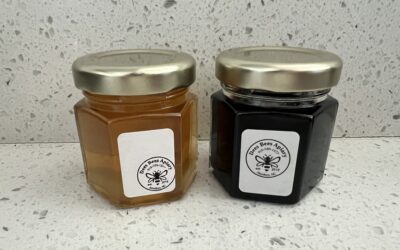
And then there is the purple stuff. Thanks to Donald, I finally got my hands on the real thing – a small, hexagon jar that arrived via snail mail. I opened the jar and marveled at its color, seeing it in person at last for the first time – even its smell was different. I treated it like liquid gold, only consuming a teaspoon at a time and, if I’m being honest, hiding it from my houseguests. Its taste is distinctly sweet, but with a slight tartness. What truly stood out to me was its pronounced berry flavor. It tastes like no honey I have ever had before, a true testament to the mysteries still hidden within the natural world. But for all of its wonder, the burning question remains: how does it get its color?
Exploring the Theories
Let’s dive deeper into some of the theories, starting with elderberry. Elderberry is the purple fruit that comes from the elder tree, scientific name Sambucus nigra, and grows across the country, save some of the pacific northwest. It has long been known for its health benefits including immune system support and antioxidant properties. Elderflowers bloom in the late spring and the berries ripen in the late summer, even as late as September. If elderberry was the source of the purple honey, it is likely we would find purple in more places than just the Sandhills.
Kudzu is another leading theory. This vining plant produces vibrant blue, purple, and red blooms in the late summer. It is part of the genus Pueraria and is considered invasive in many areas of the world. During the dust bowl era it was even marketed as a soil erosion preventative due to its climbing and covering nature and is found across North Carolina. Native to Asia, kudzu is a common plant found around the world, and yet, purple honey is only found in North Carolina. Further, there are some beekeepers who have claimed there is no kudzu growing anywhere near their purple honey-producing hives. This makes it an unlikely source of the purple as well.
Then there is the redbud theory, which doesn’t hold much water. These trees produce rosy, pink flowers in the springtime, but the buds tend to die out by summer. Redbuds are not super common in the Sandhills, and their blooming doesn’t quite align with the purple honey production. This leaves us with the berries and sourwood theories.
Common berries growing in the sandhills include blueberries, blackberries, and huckleberries. Berry plants begin blooming in spring and often remain in bloom well into the summer. And sourwood is a plant that is considered to be a small tree or large shrub, and blooms in June with cream-colored flowers that grow in clusters called racemes. It is one of the last blooming plants of the summer in the Sandhills and happens to prefer acidic and clay-based soils. Because it is the last flower to bloom in the summer, it is often associated with purple honey.
The Dearth and Donald Dees
This late bloom cycle brings us to a critical period for beekeepers: the dearth. According to Donald, the purple honey is made during this dry period where temperatures are high and there is little rainfall, and there is little to no blooming of flowers. This is typical around mid-summer in North Carolina. If there is a natural flower-based nectar available to the bees, they are going to go to that source before anything else. But what if nothing is in bloom? Where do the bees go after the sourwood goes out during the dearth?
Researchers haven’t been able to identify a pollen that matches a nectar-producing plant at the time that the purple honey is produced. This lack of pollen indicates that it might not be a flower at all that causes the purple. This is where Donald’s berry theory comes into play. If berries are the only thing available, that is where the bees of some hives may go. And with cells already full of sourwood honey, it’s possible that the berry nectar interacts to form the infamous purple honey. It could be that that precise combination, under the exact environmental circumstances is the answer. I defer to Donald: the variables are what drives the purple honey, which is precisely why it is so difficult to fully understand. It all depends on the environmental conditions of each season.

An Enduring and Tasty Mystery
So, while we can discuss the theories and taste-test the product, the truth of purple honey remains largely shrouded in mystery. Despite decades of fascination and various theories from both beekeepers and scientists, we can only guess at what combination of environmental factors, plant sources, or even bee digestive quirks truly orchestrate the purple. Like an old photograph that fades over time, my own jar of purple honey has gradually lost its original brilliant violet, settling into a rich, darker shade – but remains beautiful, nonetheless. Perhaps, as scientific techniques advance, a deeper dive into pollen analysis will eventually unlock its secrets. Until then, purple honey stands as a delicious testament to nature’s enduring puzzles, a sweet reminder that even in our modern world, there are still natural wonders waiting to be fully understood.
Want to try some purple honey for yourself? Dees Bees Apiary has it available for purchase on their website, but remember, its availability is seasonal and extremely limited. A small hex jar typically costs around $60, while a 3 oz jar is about $70. If you see it in stock, act fast – it usually sells out quickly. You can find Donald’s purple honey and much more on his website: https://deesbeesapiary.com/shop.